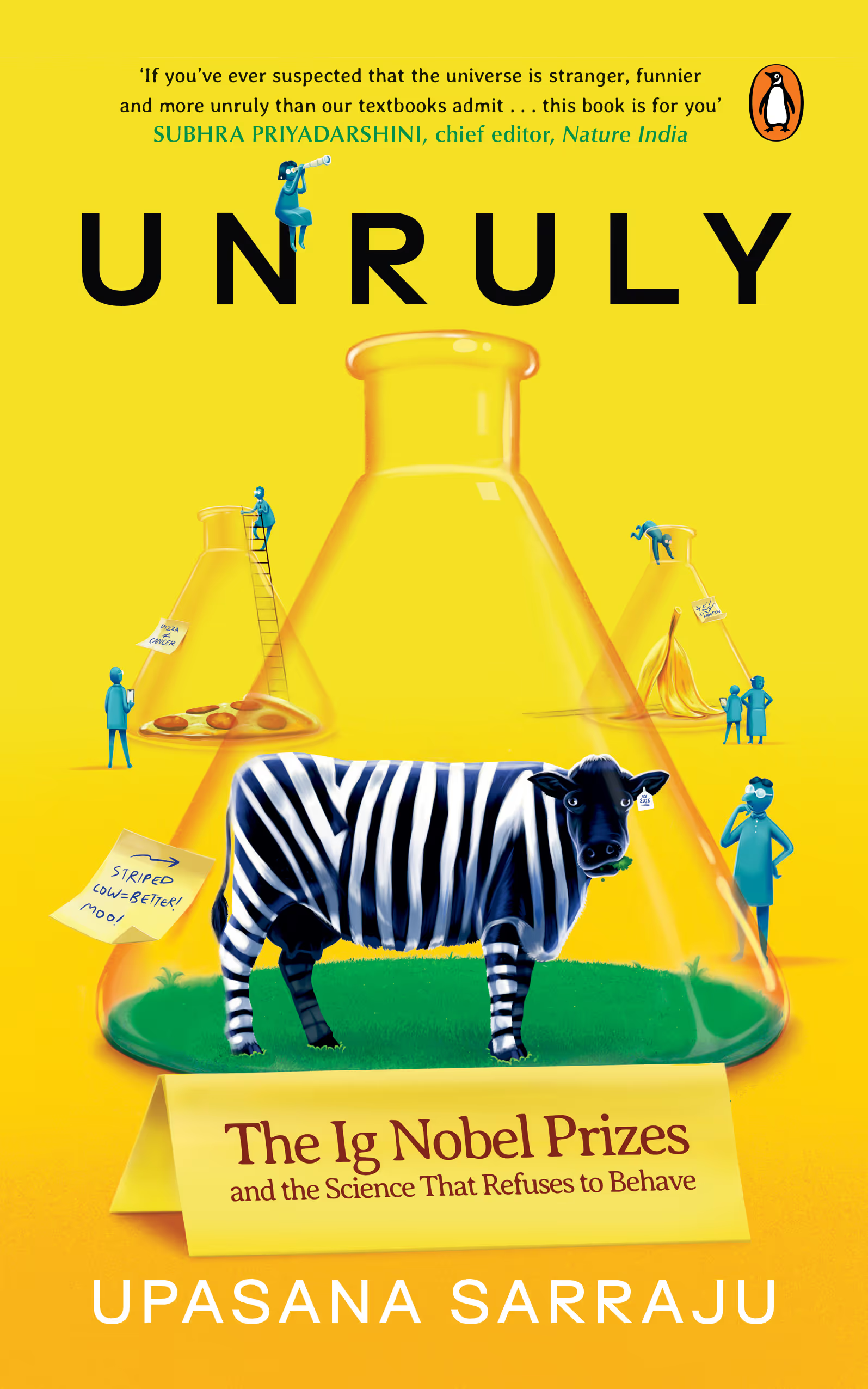


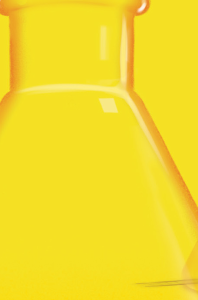
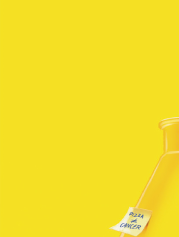








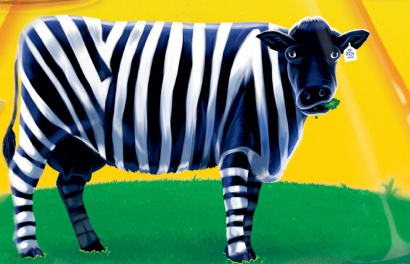







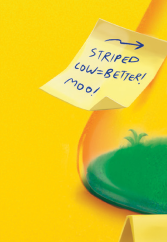










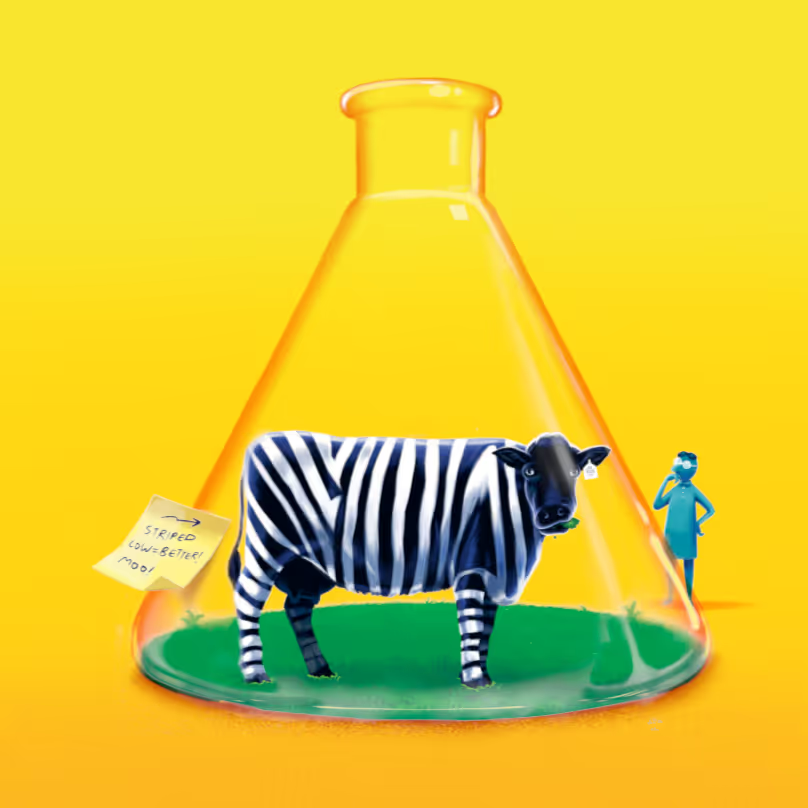
A Japanese Black cow, painted in zebra-like stripes, stands inside an oversized conical laboratory flask.
The scene references a 2025 Ig Nobel Prize–winning biology experiment that asked whether striping cattle could reduce attacks from biting flies. It could. The painted cows experienced fewer landings.
In the background, other flasks hold a slice of pizza and a banana peel — each drawn from unrelated but rigorously conducted studies.
Pizza enters through epidemiology and ecology, linked to the 2019 Medicine Ig Nobel and the 2025 Nutrition Ig Nobel. The banana peel appears by way of silly tribology; its slipperiness earned the 2014 Ig Nobel Prize in Physics.
Small blue figures move through the arrangement, measuring, recording, adjusting. They seem indifferent to scale and unmoved by hierarchy. Order is present, but only provisionally. The system functions. It also drifts.
It shows early indications of becoming… unruly.
You could be one of the adventurers.
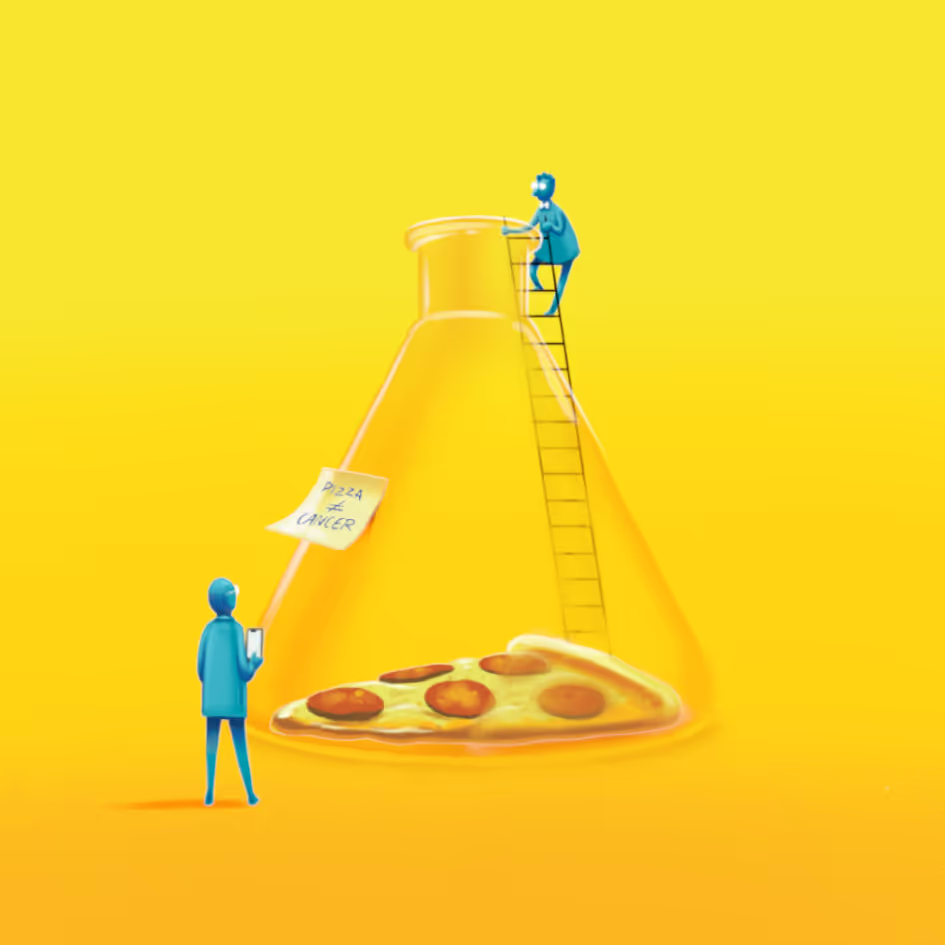

In 2019, the Ig Nobel Prize in Medicine was awarded to Dr. Silvano Gallus for “collecting evidence that pizza might protect against illness and death — if the pizza is made and eaten in Italy.”
Gallus and colleagues were studying aspects of the Italian diet, and pizza functioned as a marker—a proxy for broader Italian dietary patterns.
Across several case-control studies, they reported that regular pizza consumption was associated with a reduced risk of digestive tract cancers and acute myocardial infarction.
At the 29th First Annual Ig Nobel Prize Ceremony (Sanders Theatre, Harvard University, September 12, 2019), Dr. Gallus accepted the award and offered the following clarification:
People who regularly consumed pizza had a decreased risk of digestive tract cancer and acute myocardial infarction… In conclusion we recommend eating Italian pizza but it should be Italian. Please hold the pepperoni for health reason and also pineapple as a matter of taste.
Winners that year received a prize object consistent with the theme Habits: a paper coffee cup fixed to a base and stuffed with habit-objects (including a toothbrush, chewed gum, and a cigarette butt, among others). The ceremony also continued the long-running tradition of the 10 trillion Zimbabwean-dollar banknote being handed out as the monetary “award.”
The ceremony included at least four Nobel Prize winners presenting awards (one of whom had spent 29 years setting up a joke) and an NSFW warning delivered via live Scottish bagpiping.
Read The Winning Reseach Here If You Have Subscription To Wiley Online Library. ⬇️
In 2025, pizza reappeared in Ig Nobel history—this time for Nutrition.
The prize was awarded to Daniele Dendi, Gabriel H. Segniagbeto, Roger Meek, and Luca Luiselli for studying “the extent to which a certain kind of lizard chooses to eat certain kinds of pizza.”
The study, published in the African Journal of Ecology, examined rainbow lizards at a seaside resort in Togo (or Togolese Republic) in West Africa. The broader research question concerned behavioural adaptation.
From the paper: “The fact that all monitored individuals fed upon a same type of pizza suggests that they may have some chemical cues attracting them.”
At the 35th First Annual Ig Nobel Prize Ceremony (September 18, 2025, George Sherman Union Ballroom, Boston University), the award was presented in the presence of Nobel laureates, including Julie Mennella and Gary Beauchamp.
The ceremonial artifacts that year included:
An acceptance speech, read by Nobel Laureate Esther Duflo on behalf of the winners, included the following:
“I am deeply honoured and slightly confused to receive the Ig Nobel Prize… I knew that four-cheese pizza was irresistible.”
"My colleagues and I simply wanted to answer the age-old scientific question What happens when a lizard discovers cheese and carbs? Now,we know. And the answer is they behave like Italians."
"A special thanks to the agamas themselves for their bold dietary choices and unapologetic love of cheeses. This work proves that adaptation—like science—can be strange, surprising, and occasionally delicious."
Winners that year received a prize object consistent with the theme Habits: a paper coffee cup fixed to a base and stuffed with habit-objects (including a toothbrush, chewed gum, and a cigarette butt, among others). The ceremony also continued the long-running tradition of the 10 trillion Zimbabwean-dollar banknote being handed out as the monetary “award.”
The ceremony included at least four Nobel Prize winners presenting awards (one of whom had spent 29 years setting up a joke) and an NSFW warning delivered via live Scottish bagpiping.
Read The Winning Reseach Here If You Have A Subscription To Wiley Online Library. ⬇️
A grazing cow with zebra-like stripes stands inside an enormous conical laboratory flask. The image draws from the work of Tomoki Kojima, Kazato Oishi, Yasushi Matsubara, Yuki Uchiyama, Yoshihiko Fukushima, Naoto Aoki, Say Sato, Tatsuaki Masuda, Junichi Ueda, Hiroyuki Hirooka, and Katsutoshi Kino.
They won the 2025 Ig Nobel Prize in Biology for their striping experiments.
Tomoki Kojima, Kazato Oishi, and Say Sato collected the award and explained why they tested whether painting zebra-style black-and-white stripes onto cattle would reduce biting fly (no-see-um, sand fly or biting midge) attacks. The cow did not attend.
The premise was modest. Zebras appear to attract fewer biting flies than similarly sized ungulates. One proposed explanation is that high-contrast striping disrupts the visual processing of the flies during landing.
Rather than continuing the debate at a distance, the researchers obtained cows and paint.
The experimental design included three groups:
Fly landings and biting behaviors were counted.
The striped cows experienced significantly fewer biting fly landings than either control group. The paper said:
"We hypothesized that cows painted with black-and-white stripes on their body could avoid biting fly attacks and decrease their fly-repelling behaviors. This may be an alternative environmentally friendly practical method of controlling biting flies without the use of pesticides in animal production."
The stripes appear to interfere with the flies’ ability to execute a controlled landing.
The striped cow illustrates a recurring feature of scientific inquiry:
Observe a pattern in nature.
Apply it elsewhere.
Count what happens.
The result, in this case, was measurable. The cow remained a cow. The flies did not bite.
Read The Winning Reseach Here For Freeeeeeeeeeeeeee⬇️
In 2012, Kiyoshi Mabuchi and colleagues published a short communication in Tribology Online titled: “Frictional Coefficient under Banana Skin.”
The introduction begins with a statement of historical importance:
“Shortly after banana was imported to North America in the mid-nineteenth century, it became common sense that banana skin is slippery… The simple question how much value frictional coefficient under banana skin has not been answered, yet.”
In other words, the authors begin with a cultural observation: since the nineteenth century, banana skins have been widely understood to be slippery. No one had measured exactly how slippery.
So they did.
They built an apparatus that simulated a slipping event: a shoe sole pushed across banana skin placed on a linoleum floor. A force transducer beneath the surface measured horizontal and vertical forces during the motion.
Microscopic observation revealed that banana skin contains small gel-filled pockets within the peel.
When compressed underfoot, these structures rupture. The gel spreads into a smooth, lubricating layer.
Dry banana skin, by contrast, loses much of this effect. Other fruit peels — apple, citron, tangerine — do not perform the same way.
The banana is unusually well engineered for the task.
The 2014 Ig Nobel Prize in Physics was awarded on September 18, 2014, at the 24th First Annual Ig Nobel Prize Ceremony at Harvard’s Sanders Theatre. Kiyoshi Mabuchi sang about his work to resounding applause.
Read The Winning Reseach Here For Freeeeeeeeeeeeeee⬇️
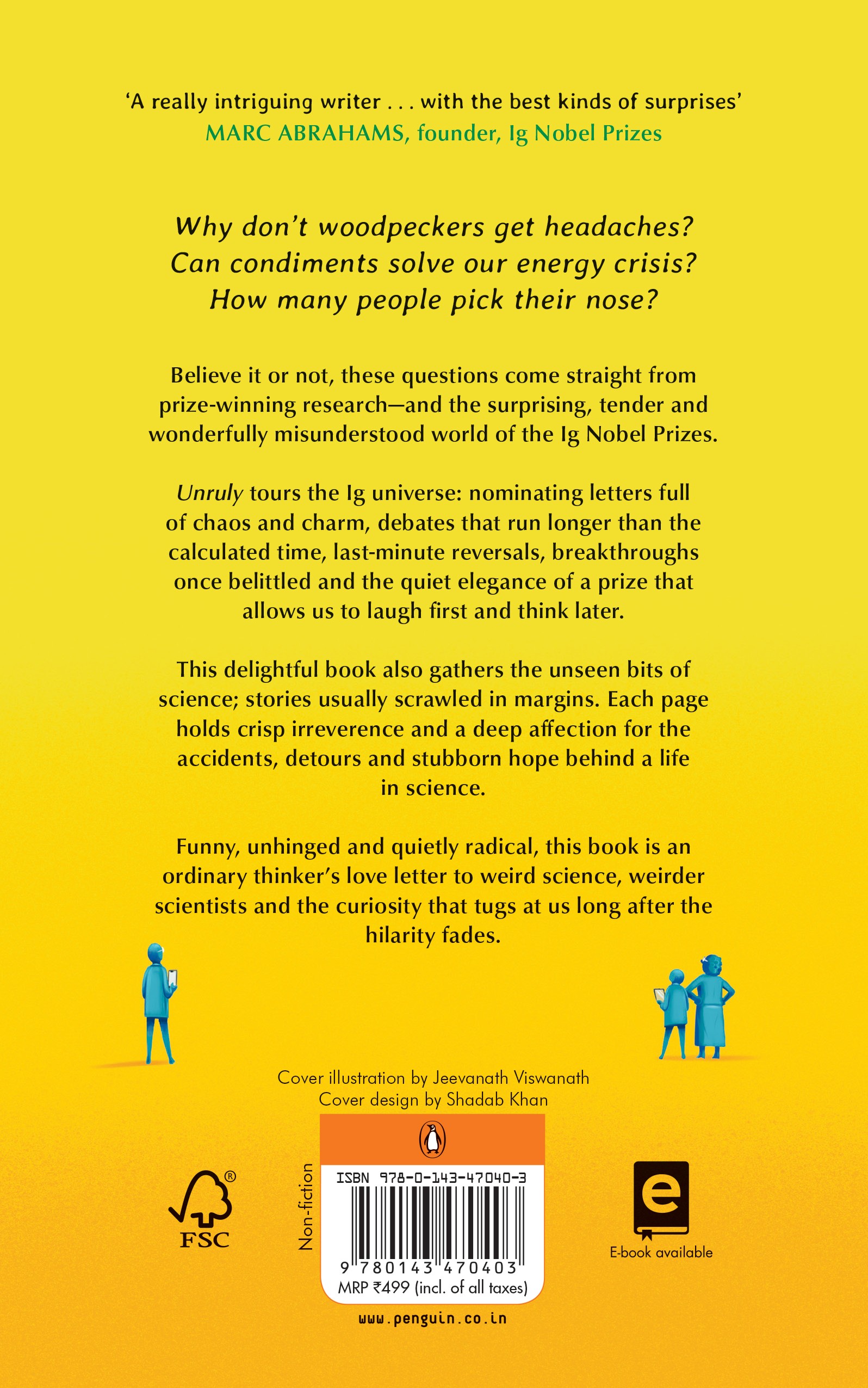
The cover was designed by Shadab Khan and illustrated by Jeevanath Viswanath.
A really intriguing writer . . . with the best kinds of surprises.
—the right honourable Marc Abrahams
Founder and Master of Ceremonies, Ig Nobel Prizes
This book made me laugh out loud. It revels in the glorious fact that science is a messy, mischievous and deeply human enterprise―one in which people spend serious careers studying ducks, woodpeckers, bedsheets, genitalia and questions that sound ridiculous until you realize they aren’t. Or until they are, and that’s the point. Confusion is not the enemy of science, boredom is. If you’ve ever suspected that the universe is stranger, funnier and more unruly than our textbooks admit―and that laughing might be a perfectly respectable way to begin understanding it―this book is for you.
—the venerable and mellifluous Subhra Priyadarshini
Chief Editor, Nature India, and Founder-President, Science Journalists Association of India
I didn’t set out to write about painted cows and slippery fruit. I just wanted to understand why some scientific questions are treated with dignified nods and others with scrunched eyebrows.
That search led me into the strange, tender, misunderstood world of the Ig Nobel Prizes—and to the scientists who risk looking ridiculous in order to discover something true.
There are scientists who study painted cows, slippery bananas, ducks, nose-picking adolescents and lizards that prefer pizza. They are not joking.
UNRULY: The Ig Nobel Prizes and the Science That Refuses to Behave, follows the people who ask questions that sound absurd—and then answer them properly. If you’ve ever felt that the most interesting ideas tend to be wild, this book was written for you.
Using the Ig Nobel Prizes—founded by THE Marc Abrahams—as a lens, UNRULY wanders through the strangest ideas you’ve never heard of: chickens who prefer certain people, plants with manifestos, slippery banana peels, nose-picking adolescents, quantum curiosities, painted cows, and other research that sounds ridiculous until you realise it isn’t.
But beneath the laughter sit two inconvenient questions:
??????? Who decides what counts as “real” science?
??????? Who decides which science stories survive?
To answer them, I spoke with scientists from NIMHANS, ISRO, CCMB, NCBS, TIFR, Georgia Tech, Lehigh University, Kerala Agricultural University, USC and beyond — across psychiatry, AI, Antarctica, ecology, molecular biology, fluid dynamics, and mathematics.
Some have won Ig Nobels. Some have won Infosys Prizes. Some have quietly changed their fields without fanfare.
All of them convinced me of one thing: curiosity has no hierarchy, even if grant committees sometimes pretend it does. If you enjoy books that are mischievous, deeply human, and slightly rebellious about how knowledge works — pre-order a copy. And if you know someone who believes science must always behave, send it to them.
Unruly will be released on February 28.